The changing landscape of global cities is the result of multi-dimensional evolution, involving multiple levels such as economy, technology, environment, and socio-culture. The role of cities in the global economic network is evolving from a single center to a multi-center, networked system. Rankings of international exchange centers show that traditional hubs such as London, Paris, and New York still lead, but cities like Beijing and Singapore are rising due to improved technological innovation and transportation connectivity. "Dual circulation hub cities" such as Shanghai and Shenzhen play a crucial role in linking domestic regional networks with global networks, becoming nodes in both internal and external circulation. Meanwhile, the competitiveness of maritime cities is showing a tiered differentiation: London, Singapore, and New York lead in economic and trade vitality and technological innovation, while Chinese cities such as Shenzhen, Guangzhou, and Qingdao are rising in the maritime economy, forming three major maritime economic zones. This change reflects a shift in cities from scale expansion to internal improvement, enhancing resilience through strengthened institutional openness and industrial chain synergy.
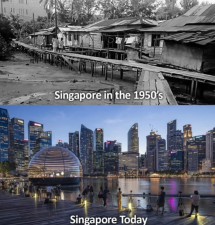
Singapore's Modernization
Singapore, now known as the "Garden City," boasts a modern waterfront charm in its Marina Bay area. Marina Bay Sands and its surrounding high-rise buildings are complemented by lush greenery and numerous pedestrian and bicycle paths. Looking back at history, this city was once a small fishing village. In 1819, it was chosen by Stamford Raffles as a trading port and gradually evolved into a port city under British influence. After Lee Kuan Yew took office, he prioritized urban planning, education, and the rule of law, revitalizing Singapore through strict management and long-term investment. Today, public space and greening are core policies in Singapore, with nearly half of the city's land area covered by green space. Its economic structure has shifted from trade and light industry to finance, services, and high-tech sectors. It can be said that Singapore's rise is due to the government's meticulous planning and continuous investment, successfully establishing it as a global financial and technological hub. However, this success is the result of long-term policy implementation and social contributions, worthy of our deep reflection.
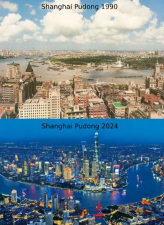
The Development of Shanghai
Looking at Shanghai, the skyline of Pudong is now completely different. Landmark buildings such as the Oriental Pearl Tower and the Shanghai Tower illuminate the Bund's night view with dazzling brilliance. However, in the 1920s, Pudong was a quiet wasteland, a far cry from its current prosperity. Since the reform and opening up in 1978, the development of Pudong has gradually been put on the agenda, officially launching after 1990, attracting a large amount of investment and talent. Foreign-invested enterprises and financial institutions flocked in, driving Pudong's industrialization and land use changes. From 1949 to 2010, Shanghai's urban expansion was accompanied by increased energy consumption and carbon emissions. Urban renewal and the emergence of high-rise buildings form a clear timeline: policy liberalization, infrastructure construction, population concentration, and the prosperity of the financial and service industries. While Shanghai's economic transformation is remarkable in its speed, it also faces new challenges such as environmental protection and transportation.
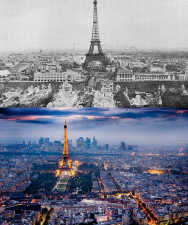
Paris: Old and New Look
Paris, a city that now blends traditional architecture with modern public spaces. Around the Eiffel Tower, historic buildings are preserved while lush pedestrian zones are added. Looking back, Paris's large-scale transformation began in the mid-19th century when Napoleon III and Baron Haussmann jointly demolished the old city walls, opened up wide roads, and built parks, laying the foundation for the city's later urban layout. In recent years, Paris has further adjusted its urban planning, reducing the number of motor vehicles, increasing bicycle lanes, and transforming parts of the city center into more pedestrian-friendly spaces. This transformation not only reflects its rich historical heritage but also its immediate needs—addressing climate challenges and transportation pressures.
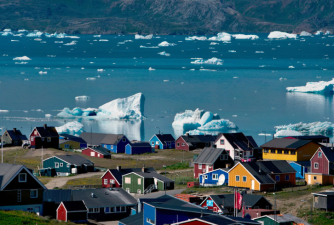
Greenland's Transformation
Let's look at small Arctic towns like Greenland. Today, they are far more modern than they were in the 1970s. Houses are brightly colored, and ports can accommodate larger ships. However, historically, around 1970, these towns primarily maintained a lifestyle of wooden houses and fishing boats. From the 1960s onwards, the Danish government began promoting centralized urbanization, building concrete apartment buildings to consolidate scattered communities. After the establishment of autonomous government in 1979, the economic focus gradually shifted from traditional fishing to tourism and resource development, with mining and tourism becoming new sources of income. But at the same time, climate change and glacial melting have brought new challenges to these regions, impacting fisheries, shipping lanes, and the ecological environment. While Greenland's modernization process has been slow, it clearly demonstrates the interplay between external policies, resource development, and climate factors.
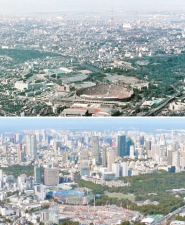
Tokyo: Technology and Tradition
Looking at Tokyo, this city now blends tradition and innovation. Skyscrapers, Tokyo Tower, and bustling streets together create the city's unique character. Following the Meiji Restoration, Japan embarked on a large-scale modernization reform, with urban planning and infrastructure construction gradually unfolding. After World War II, Tokyo was rebuilt from the ruins, with government-led infrastructure investment driving the city's rapid rise. The economic bubble of the 1980s further fueled investment and construction booms, resulting in densely packed streets and towering buildings in Tokyo. Tokyo has invested heavily in disaster prevention and earthquake adaptability, continuously improving its earthquake-resistant buildings and urban emergency response systems. Currently, redevelopment projects like Azabudai Hills are underway, aiming to enhance Tokyo's international competitiveness while addressing the challenges of an aging society and limited land resources. Tokyo's transformation reflects the essence of meticulous management; the perfect combination of macro policies and technological details has driven the city's sustainable development.
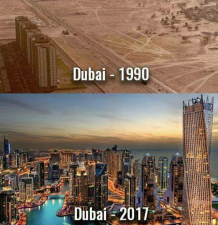
Dubai's Future Planning
Looking at Dubai, this city seems to be a perfect blend of sea and desert. The Burj Khalifa, the Palm Islands, and the World Islands together form its modern calling card. However, looking back at history, around 1860, Dubai was merely a desert camp, where tents and camels were common sights. The city's economic foundation was laid only after the discovery of oil in the mid-20th century. But the real transformation came from the visionary leadership of the local government. The late Sheikh Rashid Al Maktoum focused on investing in ports, airports, and industrial zones from the 1960s onwards, and the establishment of the Jebel Ali Free Zone attracted a large influx of foreign investment and people. In the 21st century, Dubai further transformed itself into a hotbed of tourism and speculation through large-scale projects such as Palm Islands and The World Islands. Although the 2008 financial crisis briefly hampered its development, Dubai quickly recovered. Now, the city is still planning for the future, such as the use of 3D printing technology in some buildings by 2025, undoubtedly demonstrating its determination to continue exploring new frontiers. Dubai's story is a history of urban experimentation driven by rapid capital, filled with both successes and risks.
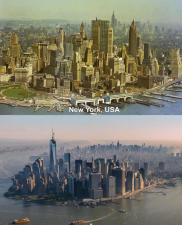
New York's Architecture Museum
The New York skyline today presents a scene where historical weight and modern innovation intertwine. From the World Trade Center completed in 2014, to the horse-drawn carriages of the early 20th century, to the Singer Building of 1908, each era has left its unique mark here. The "Roaring Twenties" of the 1920s gave rise to Art Deco skyscrapers such as the Chrysler Building. Although the attacks in 2001 destroyed the Twin Towers, New York City was quickly rebuilt, and new landmarks rose. Today, the city's skyline has become a living history museum, showcasing architectural styles from more than a dozen different eras.